Last updated on November 19, 2026
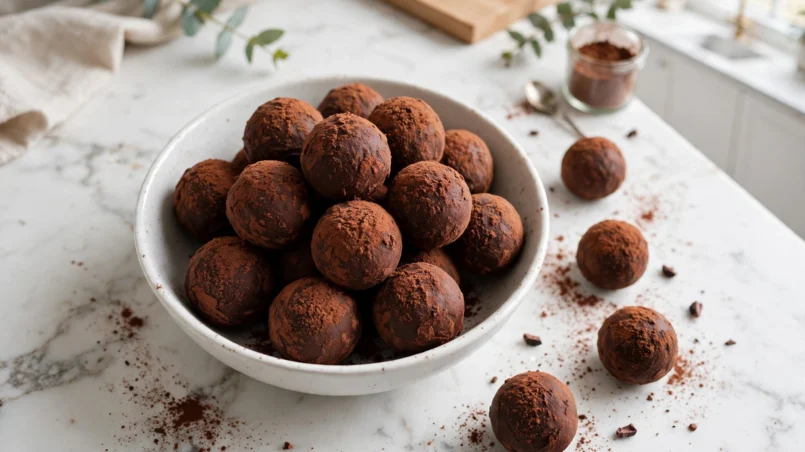
There is a chocolate shop in my town that sells truffles for four dollars apiece, and every December I watch people queue for them. Four dollars for one bite. I am not judging the queue — the truffles are genuinely wonderful — but I stopped joining it the year I realised what a truffle actually is. A chocolate truffles recipe is not a long list of exotic ingredients or a technique that takes years to learn. It is one ratio, two main ingredients, and twenty minutes of actual work. Dark chocolate, heavy cream, a little butter, vanilla and salt — that is the whole recipe. The rest is waiting for the ganache to chill and rolling it into balls with your hands. This is the recipe I make every mid-November, when the holiday gifting season starts, because a tin of thirty cocoa-dusted truffles is the best homemade gift I know: it costs a few dollars to make, it looks like it came from that chocolate shop, and it disappears faster than anything else on the holiday tray.
If you have only ever bought truffles, this recipe will surprise you twice. First, by how easy it is — if you can chop chocolate and heat cream, you can make truffles. Second, by how much better homemade truffles taste than the shop kind, because the centre is still soft and silky instead of the firm, waxy ball you get from a truffle that has sat in a display case for a week. It is the same melted chocolate you already know from our chocolate ganache recipe — just set firm enough to roll instead of poured over a cake. Same chocolate, two different forms. One is a sauce, the other is a sweet you can pick up with your fingers and give away in a tin. And once you have made it once, you will understand why this is the recipe people ask for at Christmas.
Table of Contents
- The Ratio Table
- Why This Recipe Works
- Ingredients
- How to Make Chocolate Truffles
- The Rolling Guide
- Pro Tips and Troubleshooting
- Variations
- How to Serve and Store
- Frequently Asked Questions
- Nutrition
- More Recipes You Will Love
The Ratio Table
A truffle is not a recipe with a long ingredient list — it is one ratio, and getting that ratio wrong is the only way the whole batch fails. Ganache is chocolate and cream, and the ratio between them decides what the ganache becomes. Change the ratio and you change the dessert entirely. Here is the whole table, and it is worth learning by heart:
| Ratio (chocolate : cream, by weight) | What It Makes | Use It For |
|---|---|---|
| 1 : 1 | Soft, pourable glaze | Pouring over cakes, dripping down the sides of a layer cake, dipping fruit |
| 2 : 1 | Firm ganache that sets but melts on the tongue | Rolled truffles (this recipe) |
| 3 : 1 | Very firm ganache | Dipped truffle centres with a tempered chocolate shell; milk and white chocolate truffles |
At 1:1 the ganache is a pourable glaze — that is the ratio in our chocolate ganache recipe, and it is meant to flow. At 2:1 it sets firm enough to roll but still melts on the tongue, which is the melt-in-the-mouth bite a truffle is famous for. At 3:1 it is very firm — the ratio for truffle centres that will be dipped in tempered chocolate, and the ratio you need for milk and white chocolate, because those chocolates are softer than dark and will never set at 2:1. Most failed truffles are not bad chocolate. They are too much cream — a batch made at 1:1 that never sets and collapses when you try to roll it. Weigh the chocolate and the cream, use the 2:1 ratio in this recipe, and the truffles will roll.
There is a useful contrast with our chocolate fudge recipe here, because the two sweets look like cousins and they are not. Fudge sets in a slab with sweetened condensed milk and is sliced into squares; truffles set as a rolled ganache and are dusted in cocoa. Fudge is sweet, dense and sliceable. A truffle is rich, soft-centred and bite-sized. Both belong on the same holiday tray — the fudge is the square, the truffle is the ball — and together they make a gift tin look like it came from a chocolate shop.
Why This Recipe Works
Ganache is an emulsion — cocoa butter and milk fat suspended in the water phase of the cream — and everything in this recipe exists to protect that emulsion. Here is why this version works, every single time:
- The 2:1 ratio sets the centre firm and melts it on the tongue. At two parts chocolate to one part cream by weight, there is enough cocoa butter to set the centre firm at fridge temperature and melt at body temperature. That is the whole magic of a truffle: it holds its shape in your hand and then melts the moment you bite it. At 1:1 there is not enough cocoa butter to set, and at 3:1 the centre is too firm to melt properly. Two to one is the sweet spot, and it is measured by weight, not by volume — cream measured by volume is where the ratio slips, so the recipe gives grams first.
- Bar chocolate, not chocolate chips. Chocolate chips contain stabilisers that stop them melting into a smooth ganache — they are designed to hold their shape in a cookie, which is exactly what you do not want here. A good-quality dark chocolate bar, 60 to 70 percent cocoa, chopped very fine, melts into a glossy, silky ganache. The chocolate is the whole flavour of the truffle, so use a bar you like eating.
- The five-minute rest does the melting for you. Pour the hot cream over the finely chopped chocolate and then do nothing for five minutes — do not stir, do not touch the bowl. The heat melts the chocolate gently and evenly, which is how the emulsion forms without splitting. Stir too early, when half the chocolate is still solid, and you will be tempted to stir harder, and hard stirring is what breaks a ganache. Patience here is not a nicety; it is the technique.
- Butter adds gloss and a creamy centre. Two tablespoons of unsalted butter do two quiet jobs: they give the finished ganache a glossy finish, and they make the centre creamier and softer at room temperature. Without the butter the truffles are a little firmer and a little duller; with it, the centres taste like the inside of an expensive chocolate.
- Salt amplifies the chocolate. A pinch of fine salt does not make the truffles salty. It does what salt does in every chocolate dessert on this site — it makes the chocolate taste more like itself, and it takes the edge off the richness of the cream. Do not skip it; you will notice the difference.
- Vanilla goes in after the rest. The vanilla extract is added after the five-minute rest, once the chocolate has melted, so its aroma stays in the ganache instead of cooking off in the hot cream. It is a small amount with an outsized effect — it rounds out the chocolate and makes the finished truffles smell like a chocolate shop.
- Full-fat cream is non-negotiable. The cream must be at least 35 percent fat. Half-and-half or milk will not set — there is not enough fat to form a firm emulsion, and the ganache will stay soft no matter how long you chill it. Buy heavy cream or heavy whipping cream, and check the fat content on the carton before you start.
None of this needs special equipment. A heatproof bowl, a small saucepan, a shallow dish and a small cookie scoop are all it takes — and twenty minutes from the moment you pick up the knife to the moment the dish goes into the fridge.
Ingredients
Six ingredients, all of them doing real work. Read the bar-chocolate warning before you shop: it must be good-quality dark chocolate in bar form, 60 to 70 percent cocoa — NOT chocolate chips, which contain stabilisers that stop them melting smooth. And the cream must be full-fat heavy cream, at least 35 percent fat — NOT half-and-half and NOT milk, which will never set. Those two choices decide the whole batch.
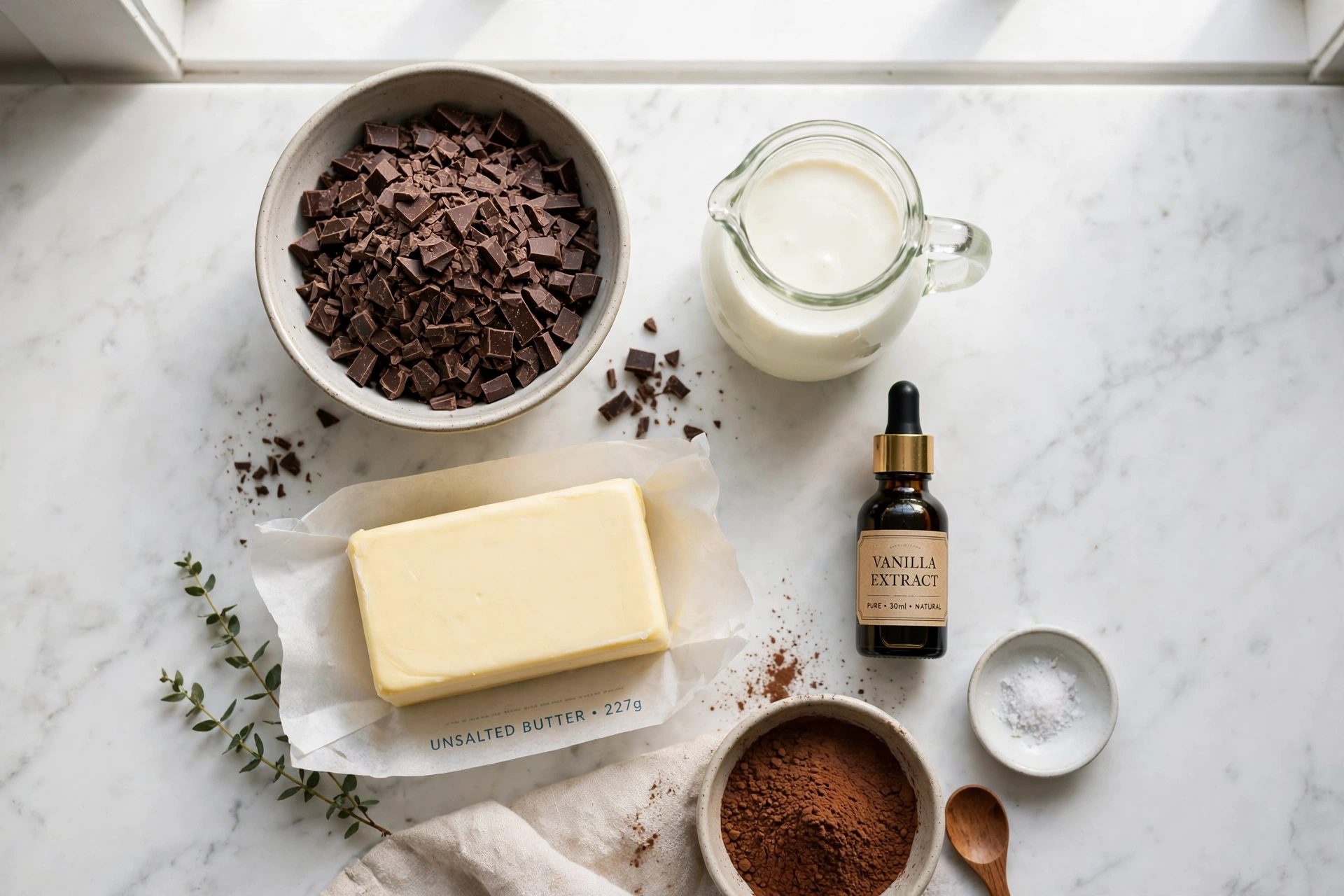
- 300 g (10.5 oz) dark chocolate, 60–70% cocoa, good-quality BAR chocolate, very finely chopped — the base of the truffles. Dark chocolate is the right call here because it sets firm and tastes intensely chocolatey; the ratio in this recipe is built for it. Chop it as fine as you can — small pieces melt evenly in the hot cream, and large chunks are the main reason a ganache ends up with unmelted bits in it.
- 150 ml (2/3 cup) heavy cream / heavy whipping cream, full-fat, at least 35% fat — the other half of the 2:1 ratio. Half-and-half or milk will not set, because there is not enough fat to form a firm emulsion. Weigh it if you can — 150 g of cream against 300 g of chocolate is the exact ratio, and weighing is where the ratio stops slipping.
- 2 tablespoons unsalted butter — for gloss and a creamy centre. Unsalted, so you control the salt yourself. Cut it into small pieces so it melts evenly with the chocolate.
- 1 teaspoon pure vanilla extract — added after the five-minute rest, so its aroma stays in the ganache. Pure extract, not imitation, if you have it — the flavour is rounder and it shows in a recipe this simple.
- 1 pinch fine salt — a small pinch amplifies the chocolate and takes the edge off the richness of the cream. Do not skip it.
- 1/2 cup unsweetened cocoa powder, for coating — more than you will use, and that is deliberate: a generous bowl of cocoa makes rolling easy, because you can roll each truffle straight in it without running out or re-filling. Unsweetened, not drinking chocolate, which is sweetened and will make the truffles too sweet on the outside.
For the dish: an 8-inch square pan or any shallow dish, and cling film pressed directly onto the surface of the ganache. The shallow dish is not a detail to skip — a deep bowl sets unevenly, firm at the edges and soft in the middle, while a shallow dish sets evenly and quickly.
How to Make Chocolate Truffles
Twenty minutes of work, eight steps, and then the fridge does the rest. The only steps that need your full attention are the heating and the five-minute rest — heat the cream gently, never boil it hard, and once you pour it, leave the bowl alone. After that, the recipe practically makes itself.
- Step 1 — Chop the chocolate fine. Put the finely chopped dark chocolate and the butter in a heatproof bowl. Chop the chocolate as fine as you can — small, even pieces melt evenly in the hot cream, and large chunks are the main reason a ganache ends up lumpy. This is the step people rush and regret, so take the extra minute here.
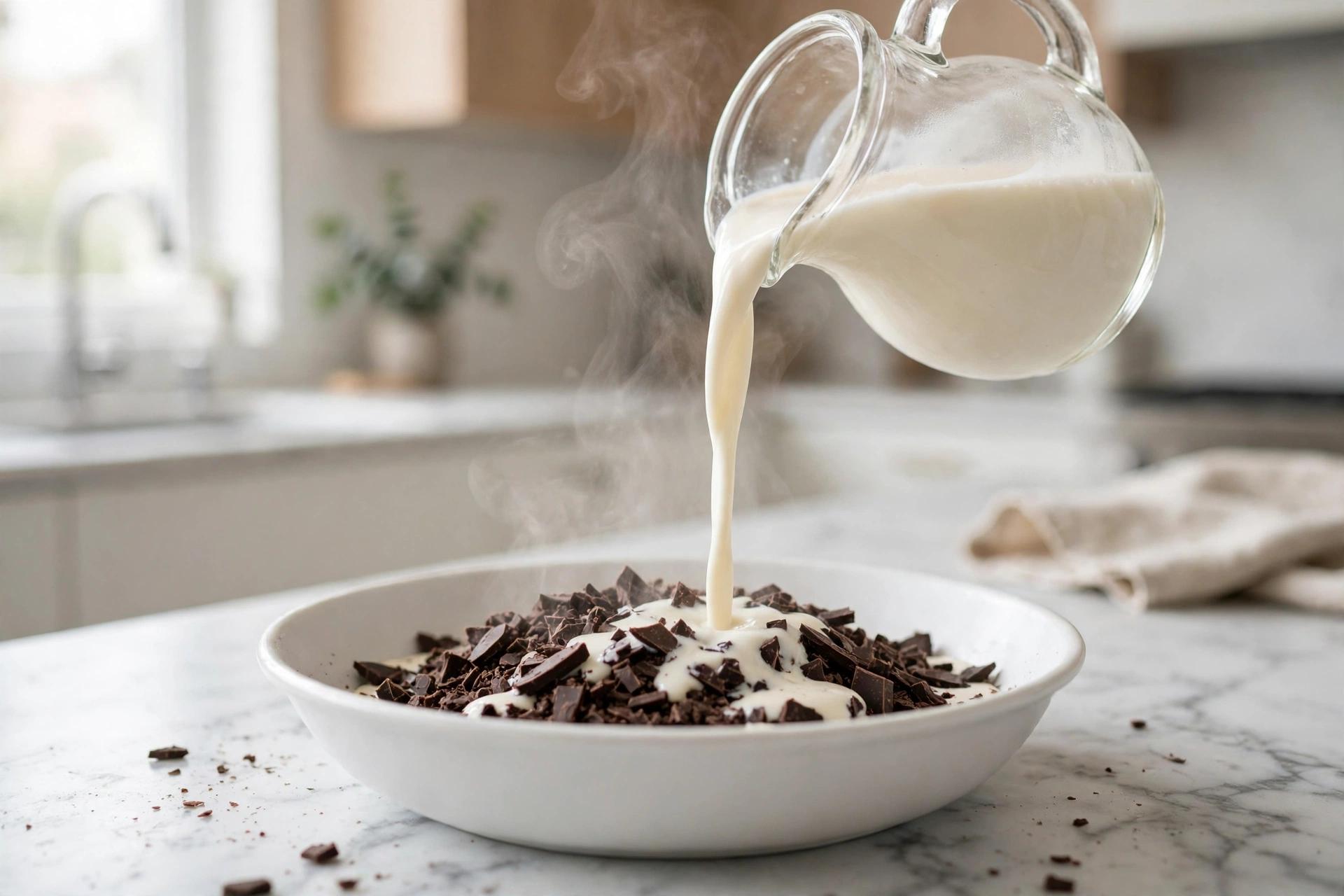
- Step 2 — Heat the cream to just simmering. Pour the cream into a small saucepan and heat it over medium heat until it is just simmering — small bubbles around the edges, about 80°C / 176°F. Do NOT boil it hard. Cream that boils hard splits the emulsion and turns the ganache oily, and you cannot undo it once it has happened. Take the pan off the heat the moment you see those small bubbles.
- Step 3 — Pour, then do nothing for five minutes. Pour the hot cream evenly over the chopped chocolate, making sure it covers all of it, and then do nothing. Do not stir, do not touch the bowl, do not peek underneath. The heat melts the chocolate gently and evenly, which is how the emulsion forms without splitting. Five minutes of doing nothing is the most important step in this recipe.
- Step 4 — Stir from the centre, add the vanilla. Add the vanilla extract, then stir slowly from the centre of the bowl outwards, in small circles, until the ganache is completely smooth and glossy. Start in the middle and let the smooth centre grow outwards — stirring in wide, fast circles from the start is what throws air and oil into the ganache. The finished ganache should look like dark, liquid silk.
- Step 5 — Cover, pour into a shallow dish, and chill. Press cling film directly onto the surface of the ganache — this stops condensation and skin forming — then pour the ganache into an 8-inch square pan or any shallow dish, so it sets evenly and quickly. Refrigerate for 1 to 2 hours, until it is firm enough to scoop but still soft enough to roll. Overnight is fine too, and the ganache keeps up to 3 days in the fridge before rolling — just let it sit at room temperature for several minutes to soften to scoopable if it has chilled longer than about 4 hours.
- Step 6 — Scoop into mounds. Scoop the chilled ganache with a small cookie scoop — about 15 g per truffle, which makes about 30 truffles — and drop the mounds onto a parchment-lined tray. Do not try to roll them yet. The mounds will look rough and uneven, and that is fine; the rolling comes next.
- Step 7 — Chill the mounds. Put the tray of scooped mounds back in the fridge for 20 to 30 minutes, so they firm up and “dry out” slightly on the surface. This is the step that makes rolling possible — a warm mound smears across your hands, a chilled mound rolls into a clean ball. If your kitchen is warm, chill them longer.
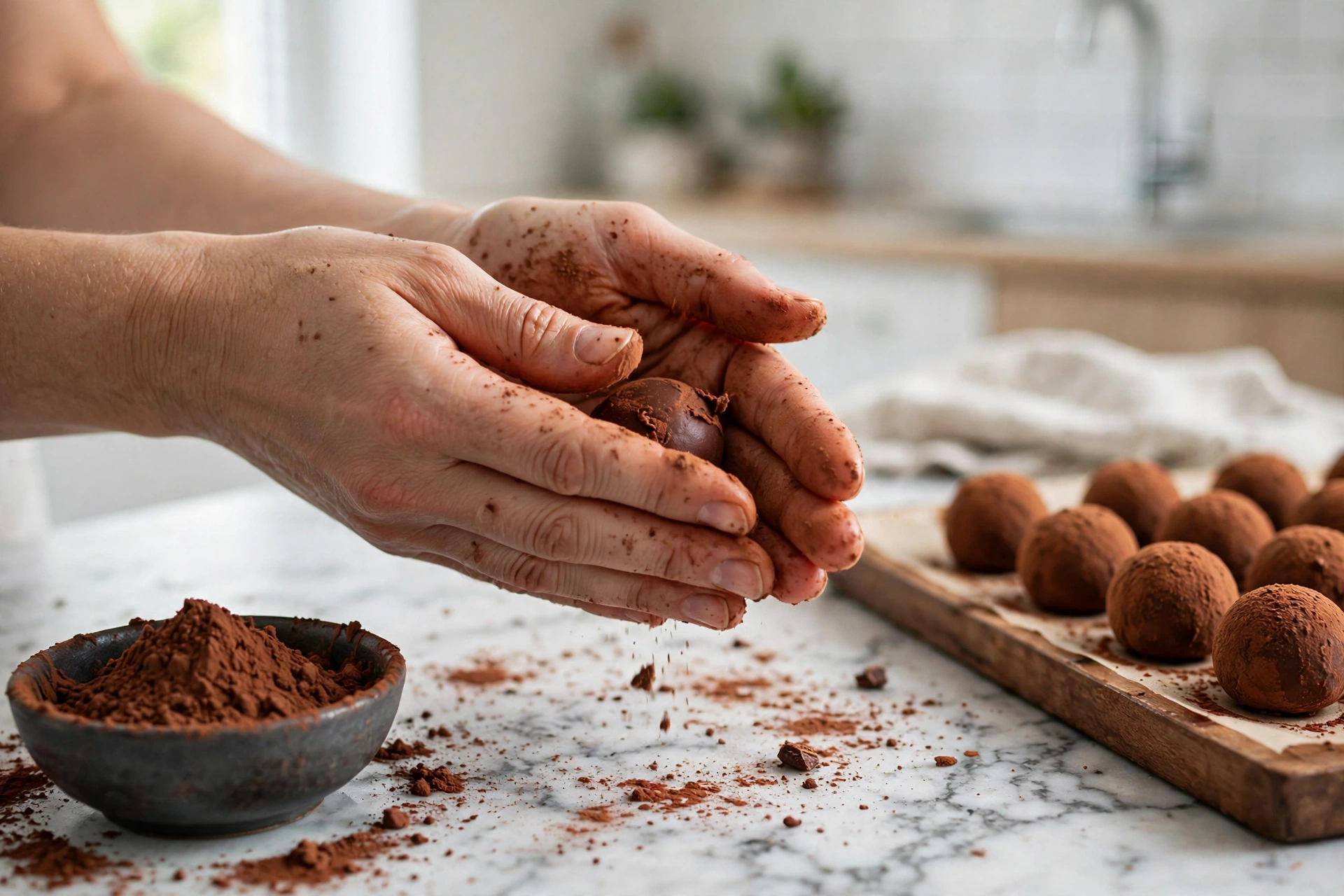
- Step 8 — Roll quickly and coat in cocoa. Roll each chilled mound quickly between clean, dry hands — or food-safe gloves, with your palms dusted with cocoa — into a ball, then roll it straight in the cocoa powder until it is fully coated. Work in small batches and put the tray back in the fridge between batches, because your hands warm the ganache fast. Then refrigerate the finished truffles until you serve them.
The Rolling Guide
Rolling is where a good batch becomes a beautiful one, and it is also where most people go wrong. The ganache looks firm after two hours, but your hands are warm, and warm hands melt ganache. Here is exactly how to get clean, round truffles:
- Scoop first, roll second. Scoop all thirty mounds before you roll any of them, and chill the mounds for 20 to 30 minutes before you start rolling. A mound that has firmed up in the fridge rolls into a ball in seconds; a mound scooped straight from the bowl smears across your palms and never rounds out.
- Work in small batches. Take five or six mounds out of the fridge at a time and leave the rest chilling. Roll those five, put them back in the fridge, and take out the next five. If the ganache starts to soften and stick to your hands, it is telling you it is too warm — put it back in the fridge for fifteen minutes and start again.
- Dust your palms with cocoa. A light dusting of cocoa powder on clean, dry hands stops the ganache sticking and gives each truffle its first coat at the same time. Food-safe gloves work too, and they keep your hands cooler for longer — dust the gloves the same way. Do not wet your hands; water and chocolate ganache do not mix, and wet hands make the truffles streaky.
- Roll fast and light. Cup the mound between your palms and roll it in two or three quick, light circles — do not squeeze it, and do not keep rolling once it is round. Every extra second in your hands warms the ganache a little more. Two or three circles, then straight into the cocoa bowl.
- Keep the room cool. A kitchen below 20°C makes rolling noticeably easier, because the ganache stays firm longer in your hands. If it is a warm day, chill the mounds longer, work in smaller batches, and roll near the fridge. If the truffles start to look shiny and soft, stop and chill everything again — the batch is not ruined, it is just warm.
Pro Tips and Troubleshooting
Most truffle problems have one of six causes, and all six are easy to fix — or to avoid entirely. Here they are, with the fix for each:
- Too soft to roll: too much cream, or not chilled long enough. Check the ratio first — if you measured the cream by volume instead of by weight, you may have used more than 150 ml. Chill the ganache longer, and if it is still soft when fully cold, the ratio was wrong: re-melt the ganache gently, stir in more finely chopped chocolate, and chill it again. Do not just keep chilling a wrong-ratio batch — chilling cannot fix too much cream.
- Too hard or crumbly: too much chocolate, or over-chilled. Leave the ganache at room temperature for 10 to 15 minutes before scooping, so it softens to scoopable. Never microwave the ganache — the microwave heats unevenly and will split the emulsion in seconds.
- Greasy or split: the cream was boiled too hard, or the ganache was stirred too aggressively. Whisk in warm cream, one tablespoon at a time, until it comes back together — or warm water at 90 to 95°F / 32 to 35°C, a teaspoon at a time. An immersion blender helps if you have one. Next time, heat the cream to just simmering and stir slowly from the centre outwards.
- Chocolate will not melt: the cream was not hot enough, or the chocolate pieces were too large. Set the bowl over a pan of gently simmering water and stir until it is smooth — the gentle heat will finish the job without splitting the ganache. Next time, chop the chocolate finer and make sure the cream is properly simmering before you pour it.
- Sticky while rolling: your hands are too warm, or the mounds were not chilled. Chill the mounds for 20 to 30 minutes, dust your palms with cocoa, and work in small batches with the tray going back into the fridge between them. A room below 20°C helps more than anything else.
- White streaks on the truffles: fat bloom, from temperature swings — the cocoa butter has risen to the surface and set there. It is safe to eat and it is appearance only; the truffles taste exactly the same. To avoid it, keep the finished truffles at a steady cool temperature and do not move them in and out of the fridge repeatedly.
Two more tips worth knowing: weigh the chocolate and the cream — grams are where the ratio stops slipping, and a kitchen scale is the cheapest insurance this recipe has. And make the ganache the day before you need the truffles. It keeps up to 3 days in the fridge before rolling, the flavours settle overnight, and rolling becomes a calm ten-minute job instead of a race against warm hands.
Variations
Once the base recipe is in your hands, it is easy to make it your own. Every variation below uses the same method — chop fine, heat the cream to a simmer, pour, rest five minutes, stir from the centre, chill, roll — with one or two changes:
- Chopped-nut coating: roll the truffles in finely chopped toasted hazelnuts or pistachios instead of cocoa powder. Toast the nuts first — it deepens their flavour and keeps them crisp — and chop them fine, so they stick to the ganache instead of falling off.
- Coconut truffles: roll the truffles in desiccated coconut instead of cocoa. Toasted coconut is even better — spread it on a tray and bake it at 325°F / 165°C for 5 to 7 minutes, stirring once, until it is golden at the edges.
- Crushed cookie crumbs: roll the truffles in finely crushed chocolate cookies or biscuit crumbs. It gives each truffle a crunchy shell and a different look on the tray, and it is a good way to use up the last cookies in the packet.
- Dipped in tempered chocolate: for a truffle with a snappy shell, dip the rolled, chilled centres in tempered dark chocolate and let them set on parchment. Use the 3:1 ratio for the centres in this version — the firmer centre holds its shape in the warm chocolate. This is the closest a home truffle gets to the chocolate-shop kind.
- Liqueur truffles: replace 30 g of the cream with Grand Marnier or dark rum — the total liquid stays the same, about 150 g, so the ratio does not change. Stir the liqueur in with the vanilla, after the five-minute rest.
- Peppermint truffles: replace the vanilla with 1/2 teaspoon of peppermint extract, stirred in after the rest, and roll the finished truffles in crushed candy canes instead of cocoa. A holiday version that disappears fast, especially in December.
- Orange truffles: add the finely grated zest of one orange to the cream as it heats, and roll the finished truffles in cocoa mixed with a little extra orange zest. Orange and dark chocolate are one of the oldest pairings in the chocolate shop, and it shows in this version.
- Mocha truffles: dissolve 1 teaspoon of instant espresso powder in the hot cream before you pour it over the chocolate. Coffee deepens the chocolate flavour without making the truffles taste like coffee — it is the same trick bakers use in chocolate cake, and it makes the finished truffles taste more intensely chocolatey.
- Milk-chocolate truffles: milk chocolate is softer than dark, so it needs about 3 parts chocolate to 1 part cream — 300 g of milk chocolate to 100 ml of cream — not the 2:1 ratio in this recipe. Use the dark ratio for milk chocolate and the centres will never roll. White chocolate needs the same 3:1 ratio.
How to Serve and Store
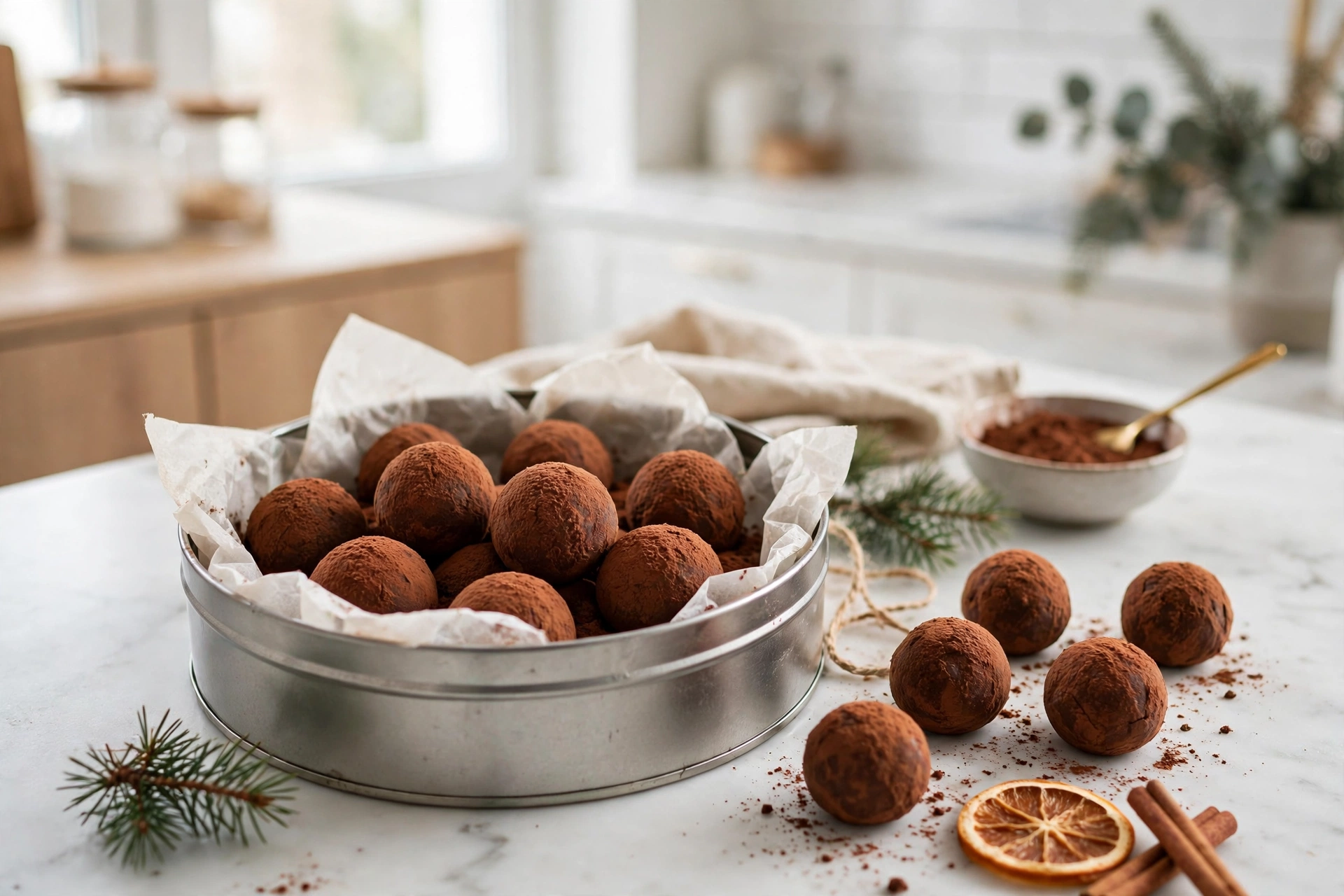
Serving: serve at room temperature, when the centres are soft enough to melt on the tongue but firm enough to pick up. Take the truffles out of the fridge 15 to 20 minutes before serving — a cold truffle is a firm truffle, and the whole point of the 2:1 ratio is the soft, melting centre. For a party, pile them in a bowl with a few candy canes and let people help themselves. For another chocolate dessert on the same table, our chocolate mousse recipe is the chilled, spoonable partner to this firm, hand-rolled one — and our hot chocolate recipe is the same melted chocolate, poured into a mug instead of rolled into a ball.
Gifting: truffles were made for giving. Layer them in a tin or a small box with wax paper between the layers so they do not stick together, and they will travel well for days. A tin of thirty is a full gift; a cellophane bag of six tied with ribbon is a stocking filler. Label the tin with the date you made them.
Room temperature: the truffles keep for 3 to 4 days at cool room temperature in a covered container. In a warm kitchen, keep them in the fridge instead — they will soften fast above 20°C.
Refrigerator: they keep for up to 2 weeks in the fridge in an airtight container, with wax paper between the layers. Let them sit at room temperature for 15 to 20 minutes before serving, so the centres soften to their best texture.
Freezer: they freeze beautifully for up to 3 months. Freeze the rolled truffles in a single layer on a tray first, then move them into a freezer bag with wax paper between the layers. Thaw in the fridge overnight, then bring to room temperature before serving. Do not thaw them on the counter from frozen — the condensation makes the cocoa coating sticky.
Make-ahead: this is a make-ahead recipe by nature. Make the ganache up to 3 days before you need the truffles, and roll them the day before serving — the flavours settle, the centres firm up properly, and there is nothing left to do on the day except take them out of the fridge twenty minutes early.
Frequently Asked Questions
Why won’t my truffles roll?
Two causes, in order of likelihood. First, too much cream — the ratio is 2 parts chocolate to 1 part cream by weight, and cream measured by volume is where the ratio slips. If the ganache is still soft when it is fully cold, re-melt it gently and stir in more finely chopped chocolate, then chill it again. Second, not chilled long enough — the ganache needs 1 to 2 hours in the fridge, and the scooped mounds need another 20 to 30 minutes before rolling. Do not just keep chilling a wrong-ratio batch; chilling cannot fix too much cream.
Can I use chocolate chips instead of bar chocolate?
No — not for truffles. Chocolate chips contain stabilisers that stop them melting into a smooth ganache; they are designed to hold their shape in a cookie, which is exactly what you do not want here. Use a good-quality dark chocolate bar, 60 to 70 percent cocoa, chopped very fine. The chocolate is the whole flavour of the truffle, so use a bar you like eating.
Can I use milk instead of cream?
No. Half-and-half or milk will not set — there is not enough fat to form a firm emulsion, and the ganache will stay soft no matter how long you chill it. The cream must be full-fat heavy cream, at least 35 percent fat. If you only have milk in the fridge, this is not the recipe to make with it.
Why is my ganache oily or grainy?
The cream was boiled too hard, or the ganache was stirred too aggressively. Cream that boils hard splits the emulsion and turns the ganache oily, and fast, wide stirring throws air and oil into it. Whisk in warm cream, one tablespoon at a time, until it comes back together — or warm water at 90 to 95°F / 32 to 35°C, a teaspoon at a time. An immersion blender helps. Next time, heat the cream to just simmering and stir slowly from the centre outwards.
How long do chocolate truffles keep?
Three to four days at cool room temperature in a covered container, up to 2 weeks in the fridge in an airtight container, and 3 months in the freezer. Thaw frozen truffles in the fridge overnight, then bring them to room temperature for 15 to 20 minutes before serving. The ganache itself keeps up to 3 days in the fridge before rolling, so you can make it ahead and roll it the day before you need it.
Can I make truffles ahead of time?
Yes — this is a make-ahead recipe by nature. Make the ganache up to 3 days before you need the truffles and keep it in the fridge, covered with cling film pressed directly onto the surface. Roll the truffles the day before serving, and they will be better for the wait — the flavours settle overnight, and rolling becomes a calm ten-minute job instead of a race against warm hands.
Can I use milk or white chocolate?
Yes, but not with the 2:1 ratio in this recipe. Milk and white chocolate are softer than dark chocolate, so they need about 3 parts chocolate to 1 part cream — 300 g of chocolate to 100 ml of cream — or the centres will never roll. Do not use the dark-chocolate ratio for them, and do not use chocolate chips for any of them.
Nutrition (Per Serving, Approximate)
Calories: 85 | Carbohydrates: 6g | Protein: 1g | Fat: 6g | Sugar: 4g
Nutrition values are estimated for 1 of 30 truffles and may vary based on exact ingredients used.
More Recipes You Will Love
| Recipe | Category |
|---|---|
| Hot Chocolate Recipe | Chocolate Treats and Candy |
| Chocolate Mousse Recipe | Chocolate Treats and Candy |
| Chocolate Ganache Recipe | Chocolate Treats and Candy |
| Chocolate Fudge Recipe | Chocolate Treats and Candy |
Chocolate Truffles Recipe
Ingredients
Method
- Chop the dark chocolate very finely and put it in a heatproof bowl with the butter.
- Heat the cream in a small saucepan over medium heat until just simmering — small bubbles at the edges, about 80°C / 176°F. Do NOT boil it hard.
- Pour the hot cream evenly over the chopped chocolate and do NOTHING for 5 minutes — do not stir.
- Add the vanilla extract, then stir slowly from the centre outwards until completely smooth and glossy.
- Press cling film directly onto the surface, pour into an 8-inch square pan or shallow dish, and refrigerate 1-2 hours until firm enough to scoop but soft enough to roll.
- Scoop with a small cookie scoop, about 15 g each, onto a parchment-lined tray — about 30 truffles.
- Chill the scooped mounds 20-30 minutes so they firm up and dry out slightly.
- Roll each mound quickly between clean, dry hands dusted with cocoa, then roll in cocoa powder until fully coated. Work in small batches and refrigerate the finished truffles.