Last updated on November 23, 2026
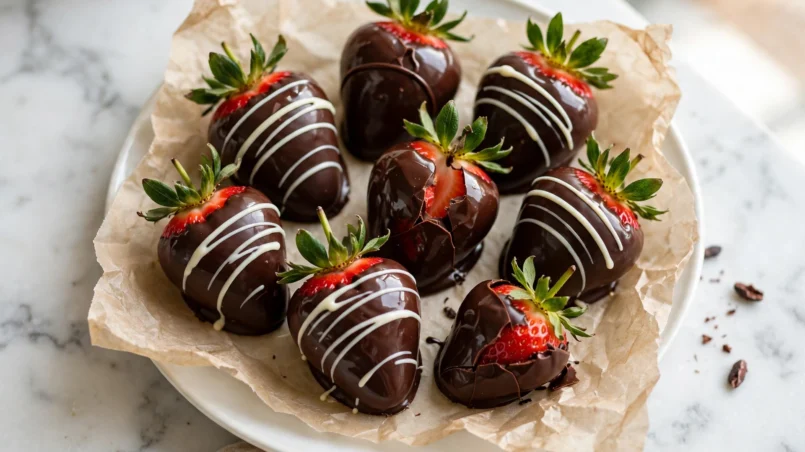
I have bought chocolate covered strawberries exactly once. It was Valentine’s Day, they came in a ribboned box, and they cost more than the dinner I cooked that night — and they were beautiful, glossy and snappy, the kind of thing that looks like it came from a shop that only makes one thing. Then I made them at home, and the first batch was a disaster: the chocolate seized into a grainy paste, the second batch set dull and sticky, and the third slid straight off the berries and pooled on the parchment. Three failures, one lesson: the dipping is not the recipe. The tempering is. This chocolate covered strawberries recipe is the version I make now — two ingredients, plus coconut oil and a white-chocolate drizzle, fifteen minutes of active work, thirty minutes to set, no oven, and a shell that shines and snaps the way the boxed ones do. It is the fastest dessert in the whole Chocolacious collection, and the only one that is a gift and a party dessert rather than a baked treat.
Chocolate covered strawberries fail for two reasons, and neither is the dipping: water on the berry, and chocolate that was never tempered. A single drop of water makes chocolate seize into a grainy paste, and untempered chocolate sets dull, soft and sticky instead of glossy with a snap. The fix is the seed-temper method, and it takes two minutes: melt two-thirds of the chocolate to 110°F, take it off the heat, stir in the remaining third until it cools to 90°F. That is the whole secret, and it is why this chocolate covered strawberries recipe works every time — the shell sets glossy, firm and snappy, and it stays that way on the platter. If you want the same chocolate served cold and creamy instead of on a berry, serve a strawberry beside a scoop of our chocolate ice cream recipe — no-churn, five ingredients, and the cold half of this dessert.
In This Article
- Why This Recipe Works
- Ingredients
- How to Make Chocolate Covered Strawberries
- The Setting Guide
- Pro Tips and Troubleshooting
- Variations
- How to Serve and Store
- Frequently Asked Questions
- More Recipes You Will Love
Why This Recipe Works
Chocolate is mostly cocoa butter, and cocoa butter is a crystal. When chocolate is melted and left to cool on its own, the cocoa butter forms unstable, loose crystals — and loose crystals are what your eye reads as dull and your teeth read as soft and sticky. Tempering is the process of forcing the cocoa butter to form stable, tight crystals instead, and the seed method does it with nothing but a thermometer and a handful of chopped chocolate. Melt two-thirds of the chocolate to 110°F, take the bowl off the heat, and stir in the remaining third until the whole bowl cools to 90°F. The unmelted seed chocolate carries stable crystals into the melted chocolate, and as the bowl cools, those crystals multiply through the whole batch. Dip at 90°F, and the shell sets glossy and hard, with the snap that makes a chocolate covered strawberry feel bought rather than made.
The second half of the recipe is the berry, and the rule is simple: it must be bone dry and at room temperature. Water is the enemy of melted chocolate — one drop makes it seize into a grainy paste, and a wet berry does the same thing from the inside out. That is why the berries are washed, patted dry, and then left for at least thirty minutes to air-dry completely. Room temperature matters just as much: a fridge-cold berry makes the chocolate set too fast and crack, and as the berry warms up, condensation forms under the shell and loosens it. The coconut oil is the third piece — a tablespoon thins the chocolate so it coats evenly instead of clumping thick, which is what makes the shell thin enough to snap rather than thick enough to chew. Dry berries, tempered chocolate, a thin coat: those three things are the whole recipe, and everything else is decoration.
Ingredients
Two ingredients, plus coconut oil and a white-chocolate drizzle — four lines on the card, and that is the whole list. The chocolate is the shell, so it is the one ingredient that cannot be a compromise: use real chocolate with cocoa butter listed in the ingredients, not compound chocolate or chips with no cocoa butter, because chocolate without cocoa butter will not temper, and untempered chocolate is exactly the dull, soft shell this recipe exists to avoid. Buy large, ripe strawberries with their stems attached — the stem is the handle, and a berry without one is a berry you have to dip with a fork.
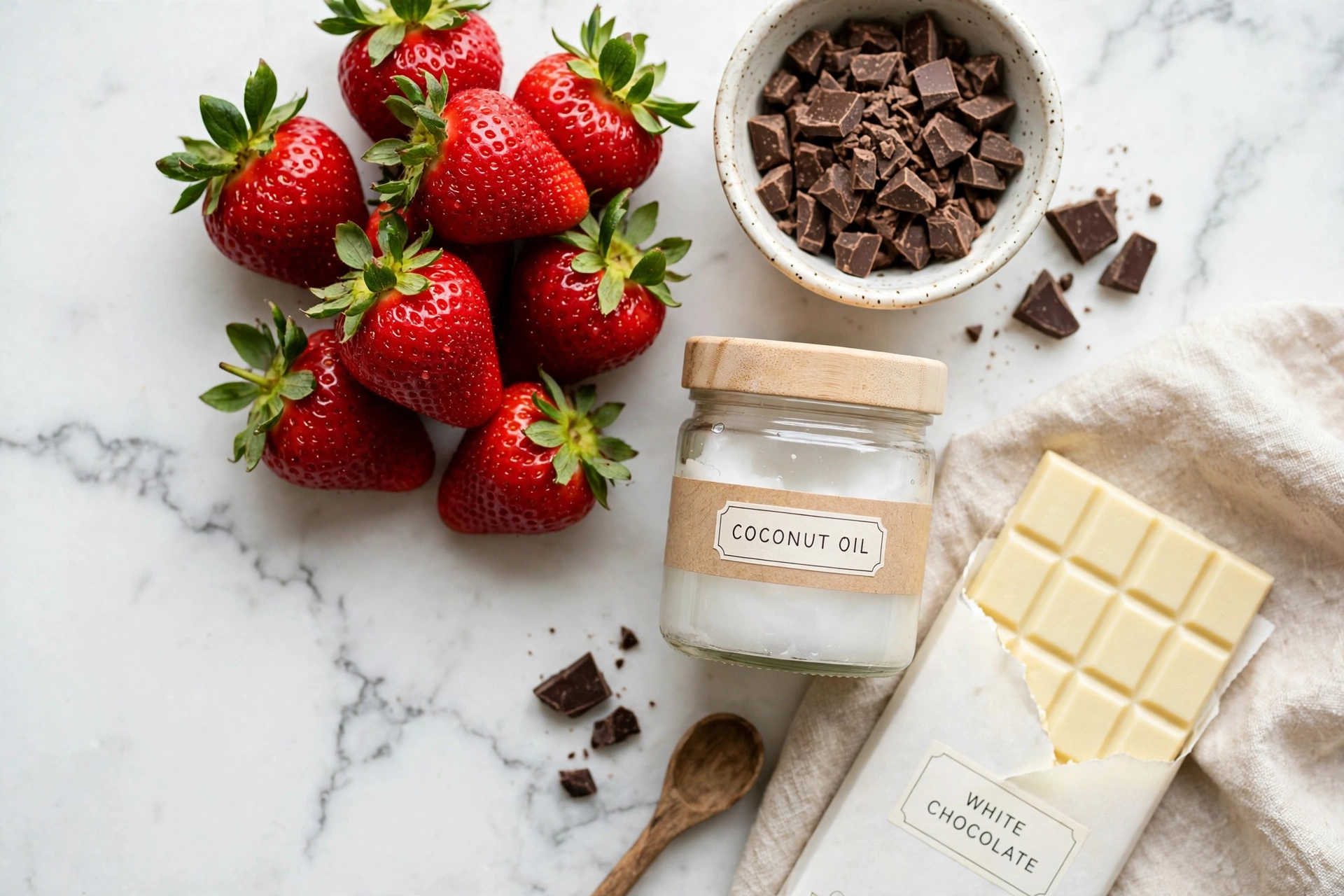
- 2 lb (900 g) large fresh strawberries, stems attached — about 25 berries, washed and dried completely, at room temperature. Pick large, ripe, firm berries with no soft spots: a soft berry leaks juice under the shell, and juice is water, and water is what makes chocolate seize.
- 12 oz (340 g) semi-sweet chocolate, bars finely chopped or chips — real chocolate with cocoa butter listed as an ingredient, such as Ghirardelli semi-sweet baking bars. Chocolate chips with no cocoa butter will not temper, and the shell will set dull and sticky. Chop bars finely so they melt evenly.
- 1 tablespoon coconut oil — optional, but worth it: it thins the chocolate so it coats evenly and sets into a thin, snappy shell instead of a thick, clumpy one.
- 4 oz (115 g) white chocolate, melted, for the drizzle — optional, for the classic zigzag finish. It is decoration and contrast, not structure, so skip it if you want the berries plain.
A note on the chocolate: check the label before you buy. If the ingredients list cocoa butter, the chocolate will temper. If it lists palm kernel oil or vegetable oil instead, it is compound chocolate: it will melt and it will set, but it will never have the shine and the snap, and no amount of careful technique will give it one. Semi-sweet is the right sweetness here — dark chocolate at 70 percent gives a sharper snap and a less sweet bite, milk chocolate is sweeter and sets softer, and both temper the same way, so the choice is yours. Whatever you pick, chop it finely: small pieces melt evenly, and even melting is what keeps the temperature under control.
How to Make Chocolate Covered Strawberries
Eight steps, fifteen minutes of active work, and then thirty minutes while the shells set. The only skill in this recipe is the temper, and the only rule is that everything the chocolate touches must be dry. Read the setting guide below before you start, because the thirty minutes at room temperature are the recipe, and the difference between a glossy shell and a dull one is decided in the two minutes of tempering, not in the dipping.
- Wash and dry the berries. Rinse the strawberries gently and pat them dry with paper towels, then leave them on a clean towel for at least 30 minutes to air-dry completely and come to room temperature. They must be bone dry — not damp, not mostly dry, dry. A single drop of water on a berry will seize the chocolate it touches, and a cold berry will crack the shell as it warms. While they dry, do not touch them with wet hands.
- Line a baking sheet. Line a baking sheet with parchment paper. The dipped berries set on this sheet, and parchment is what lets them lift off cleanly — foil sticks, wax paper softens, and a bare tray welds the chocolate to the metal. Set the sheet beside your stove, within arm’s reach of the bowl.
- Set up the double boiler. Put an inch of water in a saucepan and bring it to a simmer, then set a heatproof bowl over it — the bowl must sit above the water, not touching it. Steam is water, and water is what makes chocolate seize, so keep the heat low and the water barely simmering, never boiling. Wipe the bowl completely dry before the chocolate goes in.
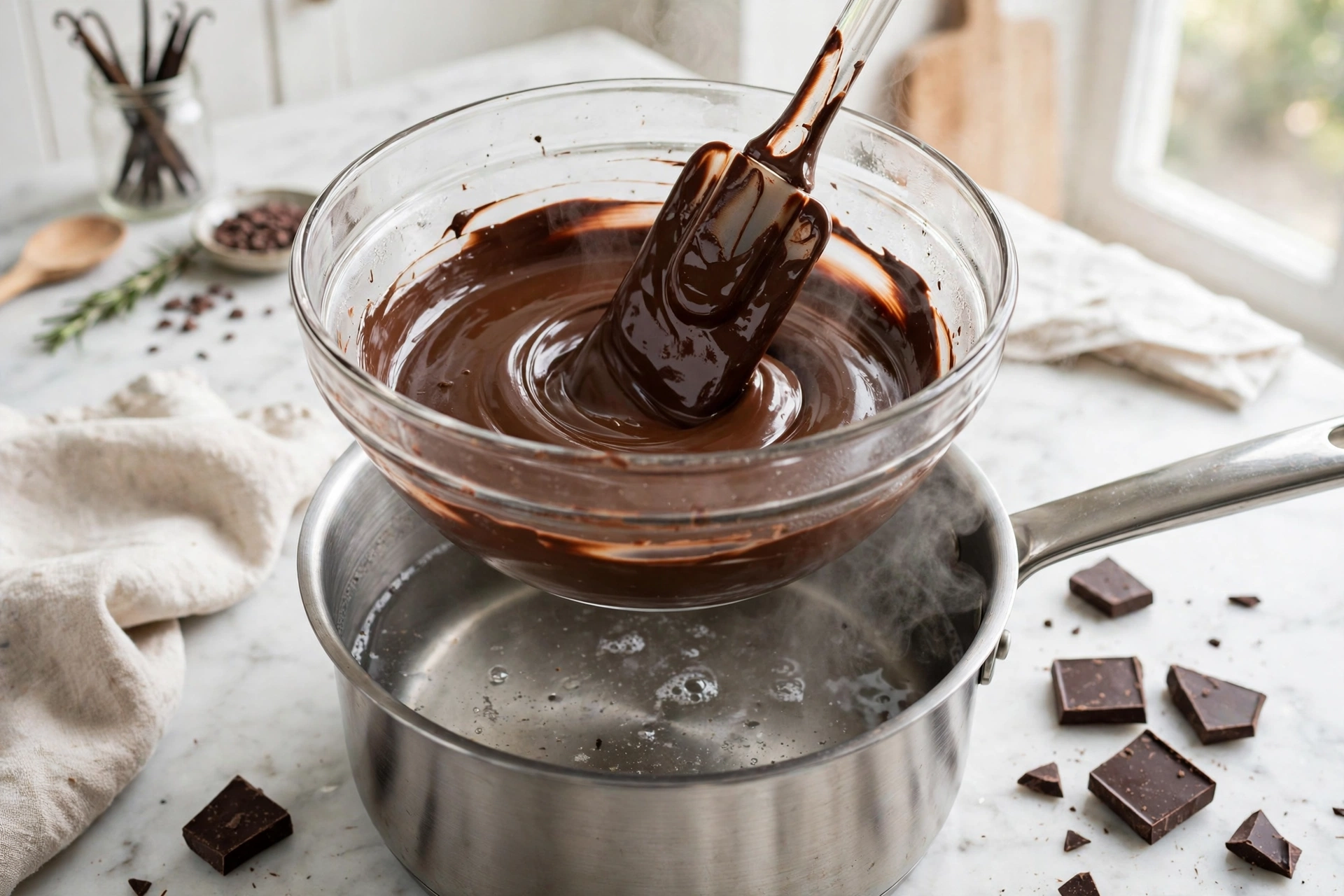
- Melt two-thirds of the chocolate to 110°F. Put two-thirds of the chopped semi-sweet chocolate and the coconut oil in the bowl and stir constantly for about 2 minutes, until it is mostly melted and reads 110°F on a thermometer. Never let it go hotter than 120°F — overheated chocolate burns, turns grainy, and will not temper back. The chocolate should look dark, smooth and glossy, like melted chocolate, not dull and thick.
- Seed it down to 90°F. Take the bowl off the heat and add the remaining third of the chopped chocolate. Stir continuously until the seed chocolate melts and the whole bowl cools to 90°F — the dipping temperature. This is the temper: the seed chocolate carries stable cocoa-butter crystals into the melted chocolate, and those crystals are what make the shell glossy and snappy. If a few small pieces refuse to melt, lift them out rather than reheating the bowl — reheating breaks the temper.
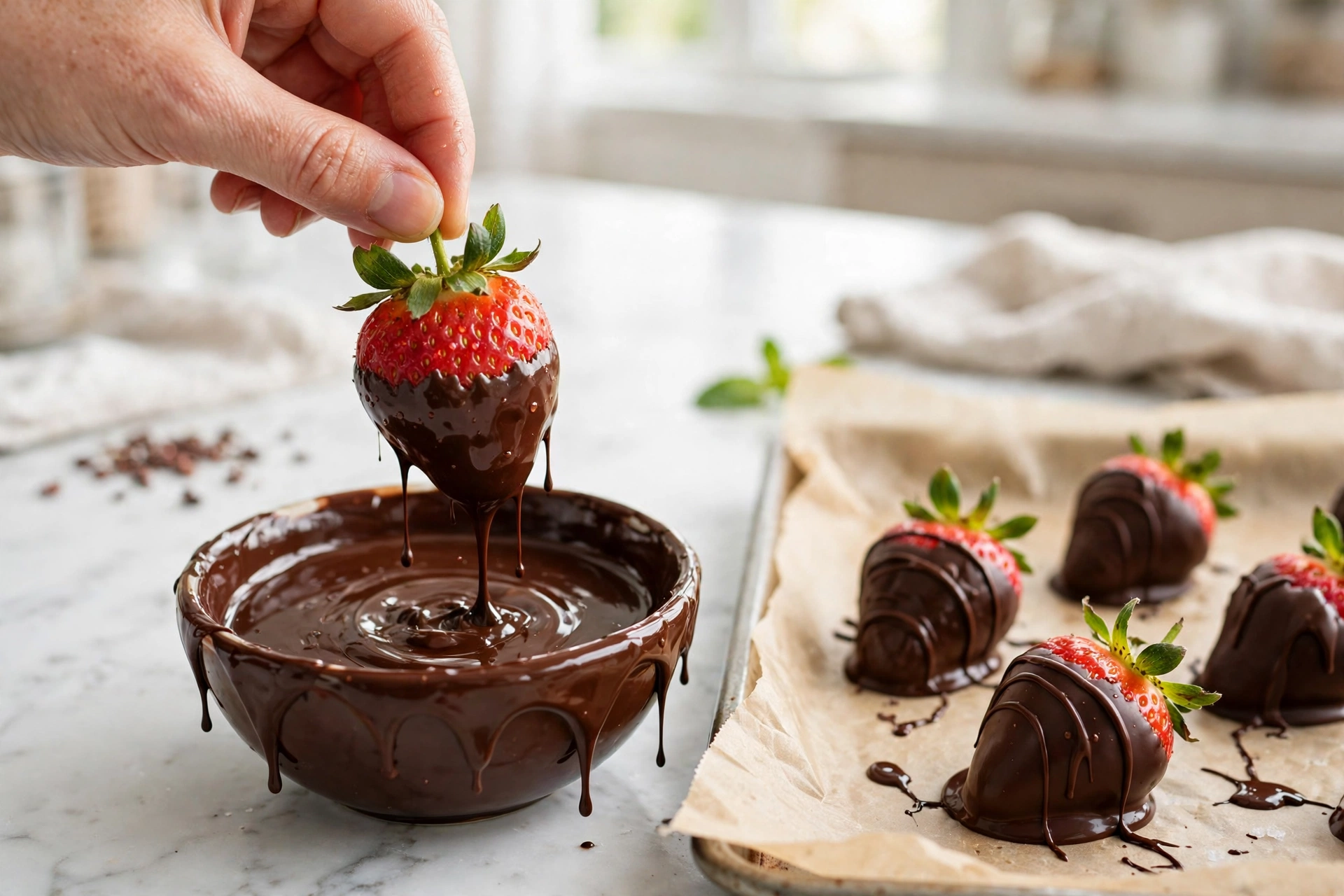
- Dip and roll. Hold one strawberry by the stem and leaves, dip it into the chocolate at 90°F and roll it until it is evenly coated, leaving a small bit of red showing at the top. Lift it out, hold it over the bowl, and let the excess drip back for a few seconds — a thin coat snaps, a thick coat chews. Place it on the parchment-lined sheet and move on to the next berry.
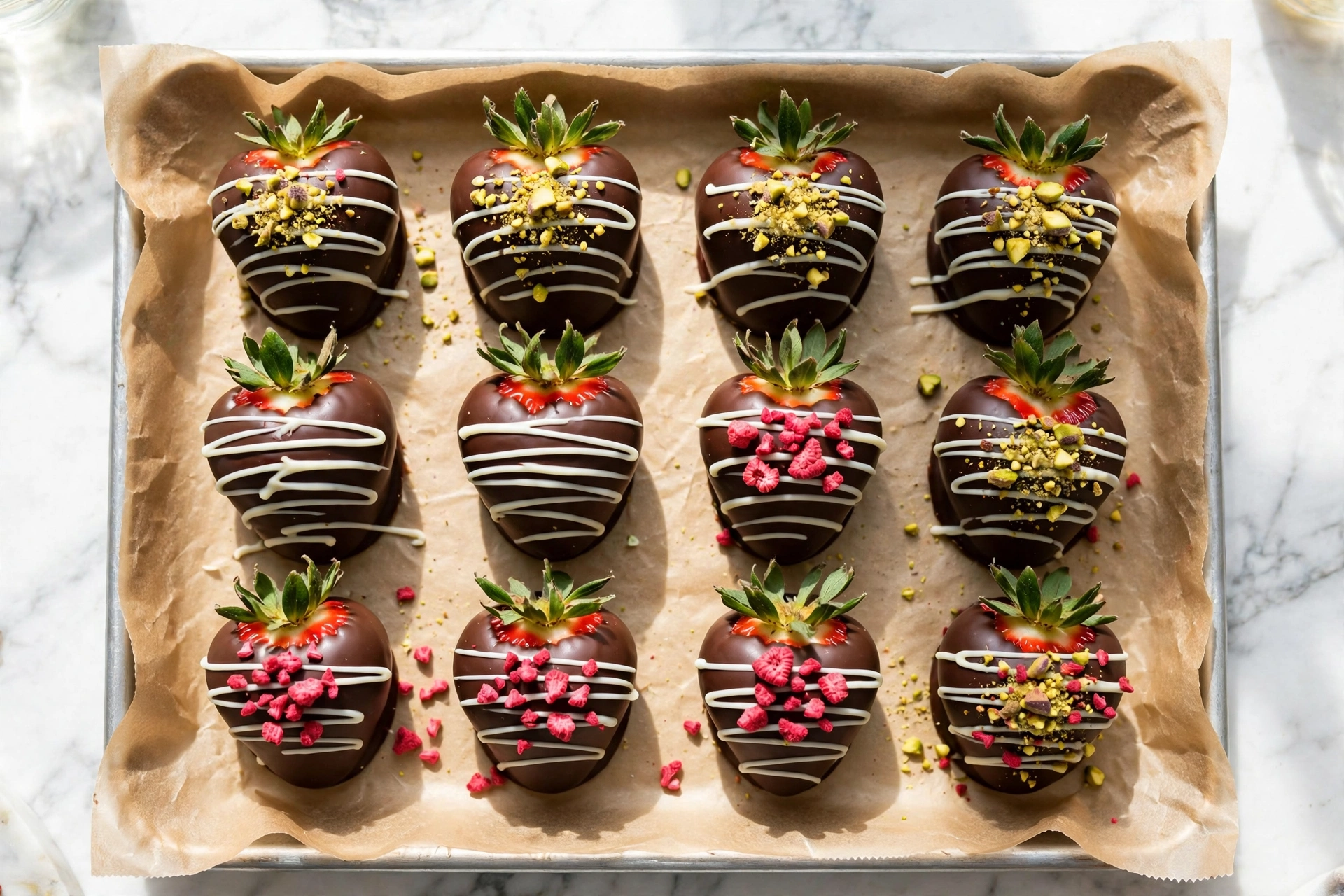
- Add toppings and the drizzle while the coating is wet. If you are topping the berries — crushed pistachios, freeze-dried raspberries, toasted coconut, sprinkles, flaky sea salt — sprinkle them on now, while the chocolate is still wet, in small batches of three or four berries at a time. Once the coating starts to set, nothing sticks to it. For the drizzle, melt the white chocolate the same way, in 30-second microwave bursts, stirring between each, then drizzle it over the set berries with a fork or a piping bag in thin zigzags.
- Let the shells set. Leave the berries at room temperature for about 30 minutes, or refrigerate for 15 minutes, until the shell is firm, glossy and snappy. Do not stack them, do not cover them, and do not move them until they are set — a fingerprint on a wet shell is there forever. The setting guide below tells you exactly how to tell they are done.
The Setting Guide
The set is the recipe, so here it is as a table. Thirty minutes at room temperature is the best set — slow, even, and glossy. The fridge is faster, but it is also where white streaks, called bloom, come from, so use it only when you are in a hurry.
| Stage | Time | What to Look For |
|---|---|---|
| Dry the berries | At least 30 minutes air-drying | Bone dry, at room temperature — no dampness, no chill on the skin |
| Active work | About 15 minutes | Melt, seed, dip, drizzle — everything done while the chocolate is at 90°F |
| Set at room temperature | About 30 minutes | Shell is firm, glossy and snappy — the best set, and the one to choose |
| Set in the fridge | 15 minutes | Faster, but the shell can bloom with white streaks in a humid fridge — use only in a hurry |
| Serve | Same day, at room temperature | Bring refrigerated berries out 15 to 20 minutes before serving so the shell is at its best |
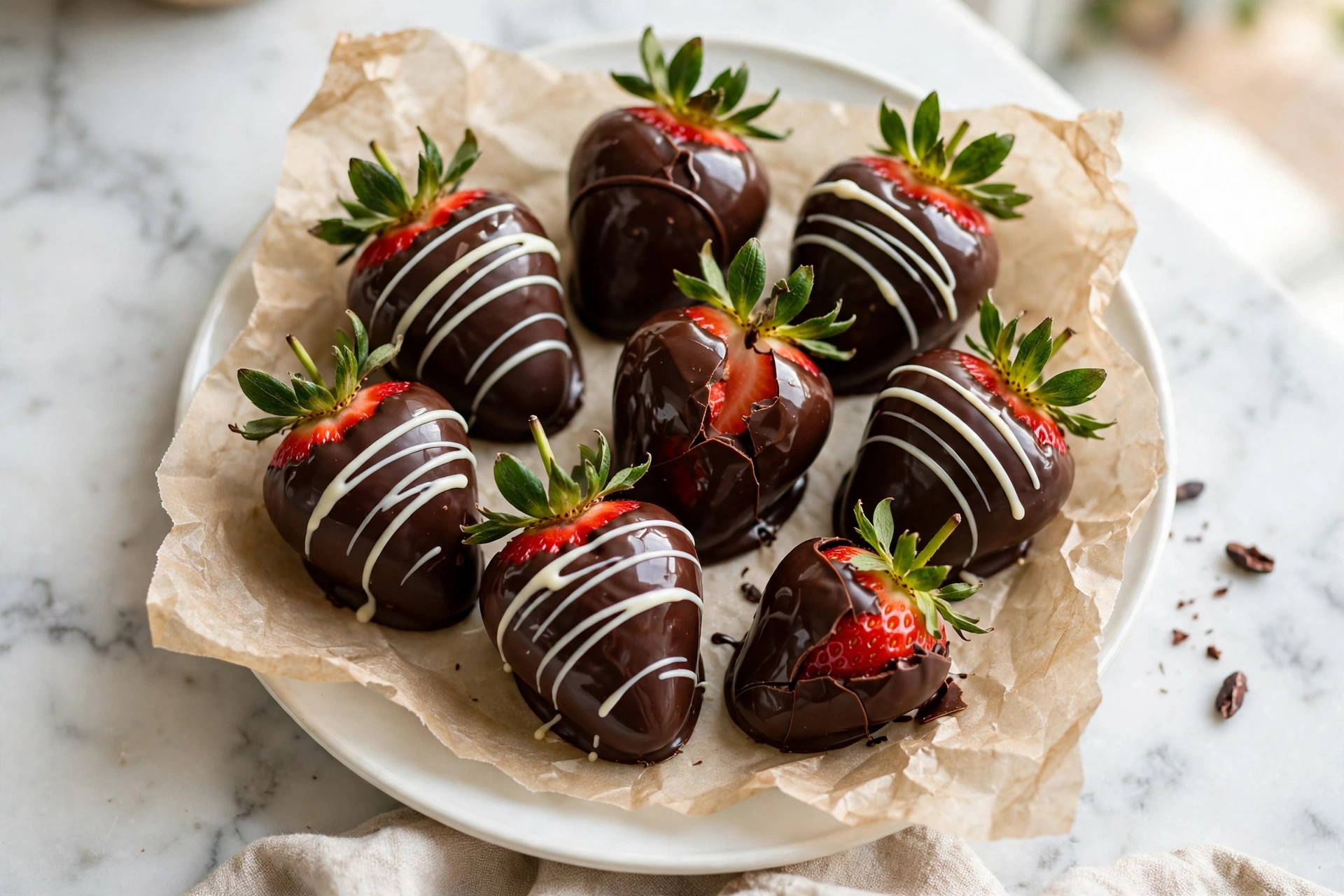
How to tell it is set: touch the shell gently with a fingertip. If it is firm, dry and glossy, and it does not give under your finger, it is ready. Bite one — a tempered shell snaps cleanly and breaks in a thin sheet, while an untempered one bends, sticks to your teeth, and tastes soft. If the shell is still tacky after thirty minutes, it was never tempered: melt the chocolate off, re-temper, and dip again — or accept a softer set and refrigerate the berries, which firms the shell even without a proper temper.
Pro Tips and Troubleshooting
Most chocolate covered strawberry problems have one of six causes, and all six are easy to fix — or to avoid entirely. Here they are, with the fix for each:
- Chocolate seized and grainy: water got in — wet berries, a wet bowl, or steam from a boiling double boiler. Seized chocolate cannot be un-seized, so start a fresh batch with a completely dry bowl and bone-dry berries. Keep the water at a bare simmer, never a boil, and never let the bowl touch the water.
- Dull, soft, sticky shell: the chocolate was never tempered. Either the seed step was skipped, or the chocolate went over 120°F and the crystals were destroyed. Melt it and re-temper — 110°F, seed down to 90°F — or accept a softer set and refrigerate the berries, which firms the shell without fixing the shine.
- Chocolate sliding off the berry: the berries were still wet or too cold. Dry them completely and bring them to room temperature before dipping — a wet berry repels the chocolate, and a cold berry sets it too fast for it to grip. The thirty-minute air-dry is not optional.
- Shell cracking: the berries were fridge-cold when dipped, or the coating is too thick. Dip at 90°F, let the excess drip off for a few seconds, and keep the coat thin — a thick shell cracks as the berry warms and expands underneath it. Room-temperature berries and a thin coat fix both causes.
- White streaks or bloom: the chocolate got too hot, over 120°F, or it set in a humid fridge. Keep the melt under 110°F while tempering, and set the berries at room temperature rather than in the fridge when you can. Bloom is harmless and the berries still taste fine — it is a look problem, not a flavour problem.
- Toppings falling off: they were added after the chocolate started to set. Sprinkle toppings while the coating is still wet, in small batches of three or four berries at a time, so each one gets its topping before the shell firms. Once the shell is set, nothing sticks to it — not even the drizzle.
Two more tips worth knowing: use a thermometer — the difference between 90°F and 100°F is the difference between a glossy shell and a dull one, and guessing is how the first batch goes wrong. And work in small batches: dip three or four berries, top them, then dip the next three or four. A tray of twenty-five wet berries is a tray of berries whose toppings have nowhere to stick.
Variations
Once the base recipe works, it takes variations happily — five of them, all built on the same tempering method, so the active work does not change:
- Milk-chocolate dip: sweeter and softer than semi-sweet, and it sets a little softer too. Temper it exactly the same way — 110°F, seed down to 90°F — and expect a lighter, creamier shell. It is the version children ask for, and the one to pick when the berries are very tart.
- Dark-chocolate dip: 70 percent dark chocolate, less sweet, with the sharpest snap of any version. The bitterness against the sweet berry is the whole point of this one, and it is the version I serve with coffee. Temper it the same way; dark chocolate is the most forgiving of the three to temper.
- Toppings bar: set out small bowls of crushed pistachios, freeze-dried raspberries, toasted coconut, sprinkles and flaky sea salt, and let everyone top their own berries while the coating is still wet. The sea salt is the surprise — a pinch of flaky salt on dark chocolate makes the chocolate taste louder, the same way it does in our chocolate covered pretzels, where the same dipping technique meets a salty-sweet base.
- Stuffed strawberries: hollow out the centre of each berry with a small knife, pipe in ganache, and then dip as usual. Use the ganache from our chocolate ganache recipe — it is the filling this variation is built for. Flag this one as a variation, not the base: it doubles the work, and the plain dipped berry is the recipe.
- Valentine’s and holiday drizzle: tint the white-chocolate drizzle pink with a drop of gel food colouring for Valentine’s Day, or drizzle dark chocolate over a white-chocolate shell for a black-and-white finish. The technique is identical — the colour is the occasion, and the shell underneath is the same tempered chocolate.
Serving: on a platter beside a warm dessert is where these berries belong — the cold, snappy shell against something warm is the whole contrast. Set them beside our chocolate lava cake recipe, the warm lava cake these berries sit beside on a dessert platter, or serve them with a mug of our hot chocolate recipe. Champagne or coffee on the side, and nothing else — the berries are the dessert.
How to Serve and Store
Serve them the same day, at room temperature, on a platter or a parchment-lined tray. They are at their best in the first few hours after the shell sets — the berry is firm, the shell is snappy, and the contrast between the cold fruit and the crisp chocolate is exactly right. If they were refrigerated, bring them out 15 to 20 minutes before serving so the shell warms to room temperature and the berry is not fridge-cold when it is bitten.
Store them in a single layer in an airtight container in the fridge for up to 2 days — never stacked, because stacking cracks the shells and the weight squeezes juice out of the berries. After two days the berries release juice, the shell softens, and the dessert is past its best. Do not freeze them: the berries go mushy on thawing, and a thawed strawberry under a chocolate shell is not a dessert anyone wants to eat.
Frequently Asked Questions
Do I need to temper the chocolate?
For a glossy, snappy shell, yes — and the seed method takes two minutes. Melt two-thirds of the chocolate to 110°F, take the bowl off the heat, stir in the remaining third until it cools to 90°F. Without tempering, the shell sets dull, soft and sticky, and it melts on your fingers the moment you pick a berry up. If you are in a hurry and do not mind a softer shell, skip the temper and refrigerate the berries — the cold firms the shell — but the shine and the snap come from the temper, and nothing else gives you them.
Why did my chocolate seize?
Water. A wet berry, a wet bowl, or steam from a boiling double boiler — one drop is enough to turn melted chocolate into a grainy paste, and seized chocolate cannot be un-seized. Dry the berries completely, wipe the bowl dry, keep the water at a bare simmer, and never let the bowl touch the water. If it seizes, start a fresh batch: the seized chocolate can be thinned with a little cream and used as a sauce, but it will never coat a berry again.
How long do chocolate covered strawberries last?
They are best the same day, and they keep up to 2 days refrigerated in a single layer in an airtight container. After that the berries release juice and the shell softens. Bring refrigerated berries to room temperature for 15 to 20 minutes before serving, and do not freeze them — the berries go mushy on thawing.
Can I use chocolate chips?
Yes, if cocoa butter is in the ingredients — check the label. Real chocolate chips temper the same way bars do. Chips with no cocoa butter, made with palm kernel oil or vegetable oil instead, are compound chocolate: they will melt and set, but they will never temper, and the shell will stay dull and soft. The label is the test, not the shape.
Why is my coating dull and sticky?
Either the chocolate was never tempered, or it was melted over 120°F and the crystals were destroyed. The fix is the seed temper: 110°F, then seed down to 90°F. If the batch is already dipped and set dull, melt the chocolate off, re-temper, and dip again — or refrigerate the berries, which firms the shell even without a proper temper.
Can I make them ahead for a party?
Dip them the morning of the party and refrigerate them in a single layer in an airtight container. Bring them out 15 to 20 minutes before serving so they come to room temperature. Do not dip them the night before — by the next evening the berries have released juice and the shells have softened, and the dessert is past its best.
Can I freeze chocolate covered strawberries?
No. The berries go mushy on thawing, the shell cracks as the fruit expands and contracts, and the whole dessert falls apart. They are a same-day dessert with a two-day fridge window, and freezing is outside it. If you have leftover berries, eat them — that is the storage plan this recipe comes with.
Nutrition (Per Serving, Approximate)
Calories: 95 | Carbohydrates: 11g | Protein: 1g | Fat: 6g | Sugar: 9g
Nutrition values are estimated for 1 of 25 strawberries, and may vary based on exact ingredients used.
More Recipes You Will Love
| Recipe | Category |
|---|---|
| Chocolate Ice Cream Recipe | Chocolate Treats and Candy |
| Chocolate Lava Cake Recipe | Chocolate Treats and Candy |
| Chocolate Covered Pretzels | Chocolate Treats and Candy |
| Chocolate Fudge Recipe | Chocolate Treats and Candy |
| Chocolate Cake Recipe | Chocolate Treats and Candy |
Chocolate Covered Strawberries Recipe
Ingredients
Method
- Wash the strawberries, pat them dry with paper towels, then leave them for at least 30 minutes to air-dry completely and come to room temperature. They must be bone dry — a single drop of water makes chocolate seize, and a cold berry cracks the shell as it warms.
- Line a baking sheet with parchment paper and set it beside your stove, within arm’s reach of the bowl. The dipped berries set on this sheet, and parchment is what lets them lift off cleanly.
- Set up a double boiler: put 1 inch of water in a saucepan and bring it to a simmer, then set a heatproof bowl over it — the bowl must sit above the water, not touching it. Wipe the bowl completely dry before the chocolate goes in.
- Put two-thirds of the chopped semi-sweet chocolate and the coconut oil in the bowl and stir constantly for about 2 minutes, until mostly melted and 110°F on a thermometer. Never let it go hotter than 120°F or the chocolate burns and will not temper.
- Take the bowl off the heat and add the remaining third of the chopped chocolate. Stir continuously until the seed chocolate melts and the whole bowl cools to 90°F — the dipping temperature — and is smooth and glossy.
- Hold one strawberry by the stem and leaves, dip it into the chocolate at 90°F and roll it until evenly coated, leaving a small bit of red showing at the top. Lift it out, let the excess drip back into the bowl for a few seconds, and place it on the parchment.
- While the coating is still wet, sprinkle on any toppings in small batches of 3 to 4 berries. Melt the white chocolate in 30-second microwave bursts, stirring between each, and drizzle it over the set berries with a fork or a piping bag.
- Leave the berries at room temperature for about 30 minutes, or refrigerate for 15 minutes, until the shell is firm, glossy and snappy. Do not stack or move them until they are set.